What is an XY-Wing?
An XY-Wing (also called Y-Wing) is an advanced Sudoku solving technique that uses a chain of three bi-value cells (cells with exactly two candidates) to eliminate candidates. The pattern involves a "pivot" cell and two "wing" cells that share candidates with the pivot, creating a logical forcing chain that reveals which candidates can be eliminated.
The technique is called XY-Wing because it involves three different candidate numbers (typically labelled X, Y, and Z), forming a Y-shaped pattern when you connect the cells that "see" each other.
The Core Structure
Pivot Cell
XY
Contains two candidates that appear in the wings
Can "see" both wing cells
Wing Cell 1
XZ
Shares candidate X with the pivot
Contains common candidate Z
Wing Cell 2
YZ
Shares candidate Y with the pivot
Contains common candidate Z
Visual Representation
The XY-Wing Structure
If the target cell can see both wings, eliminate Z
The Logic Behind XY-Wing
The Forcing Chain
The XY-Wing works through a simple but powerful logical argument:
- Case 1: If the pivot is X, then Wing 2 (YZ) must be Z (because Y is taken by the pivot)
- Case 2: If the pivot is Y, then Wing 1 (XZ) must be Z (because X is taken by the pivot)
- Conclusion: Either way, one of the two wings MUST be Z
- Elimination: Any cell that can see both wings cannot be Z (because one wing will definitely be Z)
Identifying an XY-Wing
Step-by-Step Process:
- Find a bi-value cell to use as your pivot (a cell with exactly two candidates, e.g., {3,5})
- Look for two more bi-value cells that the pivot can "see" (in the same row, column, or box)
- Check candidate alignment:
- Wing 1 shares one candidate with the pivot (e.g., {3,7})
- Wing 2 shares the other candidate with the pivot (e.g., {5,7})
- Both wings share a common candidate (7 in this example)
- Identify elimination targets: Find cells that can see both wings
- Eliminate the common candidate (Z) from all target cells
- All three cells must be bi-value (exactly two candidates each)
- The three cells must contain exactly three different numbers total
- The pivot must "see" both wing cells
- Both wings must share a common candidate (Z)
- There must be at least one cell that sees both wings (otherwise no elimination possible)
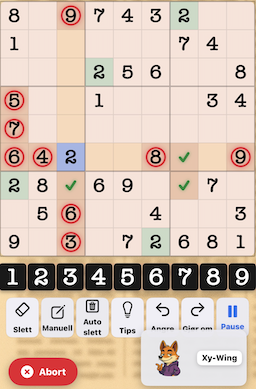
Analysing the Example
Understanding the XY-Wing Pattern
In the displayed puzzle, we can observe several elements that demonstrate an XY-Wing in action:
Red Circled Numbers: Several bi-value cells are marked with red circles:
- Row 1, Column 2: 9
- Row 4, Column 1: 5
- Row 5, Column 1: 7
- Row 6, Column 1: 6
- Row 6, Column 2: 4
- Row 8, Column 2: 6
- Row 9, Column 2: 3
- Row 6, Column 5: 8
- Row 6, Column 9: 9
These red circles mark bi-value cells (cells with exactly two candidates) that are being analysed for potential XY-Wing patterns. When searching for XY-Wings, you need to identify sets of three bi-value cells with the right candidate relationships.
Green Check Marks (✓): Three green check marks appear at strategic positions:
- Row 6, Column 6 (✓)
- Row 7, Column 3 (✓)
- Row 7, Column 7 (✓)
These check marks indicate cells where candidates have been successfully eliminated as a result of identifying the XY-Wing pattern. The cells marked with green checks can "see" both wing cells of the XY-Wing, allowing the common candidate to be eliminated.
Reconstructing the XY-Wing
To understand how this XY-Wing works, consider the pattern formed by the red-circled cells:
- Identify the pivot: One of the red-circled bi-value cells acts as the central pivot that "sees" both wings
- Identify wing 1: A bi-value cell that shares one candidate with the pivot
- Identify wing 2: A bi-value cell that shares the other candidate with the pivot
- Find the common candidate: Both wings contain a candidate Z that doesn't appear in the pivot
- Apply elimination: The green check marks show where candidate Z was eliminated (cells that see both wings)
The Logical Chain: Looking at the concentration of red circles in column 1 and column 2, along with the distribution of check marks in rows 6 and 7, we can see the XY-Wing pattern at work. The pivot cell connects to both wings through shared candidates, and the forcing chain logic guarantees that one wing must contain the common candidate Z, allowing eliminations in cells that see both wings.
Worked Example
Complete XY-Wing Scenario
Setup:
- Cell A1 (Pivot): candidates {2,5}
- Cell A7 (Wing 1): candidates {2,8} – shares 2 with pivot
- Cell D1 (Wing 2): candidates {5,8} – shares 5 with pivot
Analysis:
- Pivot sees both wings (A1 sees A7 via row, sees D1 via column)
- Both wings contain 8 (the common candidate Z)
- Pattern confirmed: Pivot={2,5}, Wing1={2,8}, Wing2={5,8}
Logic:
- If pivot is 2 → Wing 2 cannot be 5 → Wing 2 must be 8
- If pivot is 5 → Wing 1 cannot be 2 → Wing 1 must be 8
- Either way, one of the wings is definitely 8
Elimination:
Cell D7 can see both Wing 1 (A7, same row D) and Wing 2 (D1, same column 7). Since one of these wings must be 8, cell D7 cannot be 8. Eliminate 8 from D7!
Finding XY-Wings Systematically
Strategy 1: Pivot-First Approach
- Scan for bi-value cells throughout the grid
- Choose one as a potential pivot (e.g., {3,7})
- Look in its row, column, and box for other bi-value cells
- Check if two of them form wings:
- One shares the first candidate (e.g., {3,9})
- One shares the second candidate (e.g., {7,9})
- Both have a common third candidate (9)
- Find cells that see both wings and eliminate the common candidate
Strategy 2: Wing-First Approach
- Find two bi-value cells that share a candidate (e.g., {4,6} and {4,8})
- Note their common candidate (4) and unique candidates (6 and 8)
- Search for a pivot cell with those two unique candidates ({6,8})
- Verify the pivot sees both potential wings
- If confirmed, eliminate the common candidate (4) from cells seeing both wings
Types of XY-Wings
Standard XY-Wing
The classic pattern where all three cells are connected through direct visibility (same row, column, or box relationships).
Remote XY-Wing
A more complex variant where the wings might not be in direct visibility of each other, but are still connected through the pivot. The elimination principles remain the same.
XY-Chain Extension
XY-Wings can be seen as the simplest form of XY-Chains, which extend the concept to longer chains of bi-value cells. Understanding XY-Wings is the foundation for mastering XY-Chains.
Common Mistakes to Avoid
- Using cells with more than two candidates: All three cells must be bi-value – no exceptions
- Wrong candidate alignment: The wings must share exactly one candidate each with the pivot, and share a third candidate with each other
- Visibility errors: The pivot must see both wings, but the wings don't need to see each other
- Eliminating from wrong cells: Only eliminate from cells that can see BOTH wings, not just one
- Eliminating the wrong candidate: Only eliminate the candidate that appears in both wings (Z), not X or Y
- Missing the pattern: Sometimes the three cells are spread far apart – don't limit your search to nearby cells
When to Look for XY-Wings
XY-Wing patterns become more visible when:
- You have many bi-value cells in the grid (typically after applying intermediate techniques)
- Simpler techniques (singles, pairs, locked candidates, X-Wing) no longer yield results
- The puzzle is rated as difficult or expert level
- You notice multiple bi-value cells with overlapping candidates
- Pencil marks are complete and accurate
Relationship to Other Techniques
Building on Simpler Methods
Before looking for XY-Wings, ensure you've exhausted:
- Naked and Hidden Singles
- Naked and Hidden Pairs/Triples
- Locked Candidates
- X-Wing and Swordfish
Gateway to Advanced Techniques
XY-Wing opens the door to understanding:
- XYZ-Wing (involves three candidates in the pivot)
- XY-Chains (longer chains of bi-value cells)
- Alternating Inference Chains (AICs)
- Other forcing chain techniques
Practice Strategy
Building XY-Wing Recognition:
- Master bi-value cell identification – they're the foundation of XY-Wings
- Mark bi-value cells distinctly – use colours or special notation
- Practice with solved puzzles – search for XY-Wing patterns with the solution available
- Start with pivot-first method – it's usually more intuitive for beginners
- Verify candidate relationships carefully – check and double-check the pattern
- Draw the connections – sketch lines between pivot and wings to visualize the pattern
- Check for eliminations – carefully identify which cells see both wings
- Confirm your logic – trace through both cases (pivot=X, pivot=Y) to verify
Advanced Tips
Quick Candidate Check
When evaluating a potential XY-Wing, count the total unique candidates across all three cells. There should be exactly three different numbers. If there are four or more, it's not an XY-Wing.
Common Candidate Frequency
The common candidate (Z) that appears in both wings is often a number that appears moderately frequently in the grid – typically 3-5 remaining instances. Very rare or very common numbers less frequently form useful XY-Wings.
Box-Line Intersections
XY-Wings that span box-line intersections (where the pivot is in a box, one wing is in the same row, another in the same column) are particularly common. Focus your search on these configurations.
Why XY-Wing Matters
Powerful elimination: A single XY-Wing can eliminate multiple candidates, often creating breakthrough moments in difficult puzzles.
Logical certainty: Unlike guessing, XY-Wing provides guaranteed eliminations based on pure logic.
Pattern recognition training: Learning XY-Wing develops your ability to see forcing chains and logical relationships.
Gateway technique: Mastering XY-Wing makes learning other advanced techniques significantly easier.
Satisfaction factor: Finding your first XY-Wing is a memorable milestone that confirms you've reached advanced solving ability!
Conclusion
The XY-Wing represents a significant step up in Sudoku solving sophistication. Unlike techniques that examine direct constraints within single units, XY-Wing introduces the concept of forcing chains – logical arguments that trace through multiple cells to reach inevitable conclusions.
The elegance of XY-Wing lies in its simplicity once understood: three bi-value cells with the right candidate relationships create an unstoppable logical force. Either the pivot is X (forcing a wing to be Z) or the pivot is Y (forcing the other wing to be Z). This binary logic guarantees eliminations without any uncertainty.
Mastering XY-Wing requires patience and practice. You'll need to develop strong pattern recognition skills, maintain accurate pencil marks, and think through logical chains carefully. However, the investment is worthwhile. XY-Wing not only solves difficult puzzles but fundamentally changes how you perceive Sudoku – from a puzzle of direct constraints to a rich network of logical implications and forcing chains.
As you practice XY-Wing, you'll find that the patterns begin to emerge naturally from the grid. What once seemed impossibly complex becomes recognizable in seconds. This progression from confusion to clarity is one of the great joys of Sudoku mastery, and XY-Wing is one of the technique's most rewarding achievements.