Simple Colouring Sudoku Technique Explained

Unlock logical contradictions with colour coding

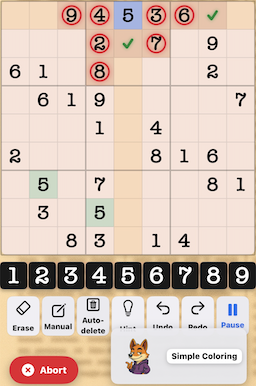
Simple Colouring pattern example in Sudoku

What is Simple Colouring?

Simple Colouring is a powerful intermediate Sudoku technique that uses logical reasoning to eliminate candidates by assigning them alternating "colours" (or labels). When candidates of the same number form a chain where they can "see" each other, we can colour them alternately to reveal contradictions or eliminations.

The technique is called "simple" because it focuses on straightforward conjugate pairs – positions where a candidate must be in one cell or another, with no other options in that unit.

5
Colour A candidates (one chain)
5
Colour B candidates (opposite chain)
5
Confirmed placement or analysis cell

The Core Principle

Simple Colouring is based on a fundamental logical rule: if two cells in the same unit (row, column, or box) can only contain the same candidate number, and one of them must be true, then they must have opposite truth values.

Key Logic: When we create a chain of alternating colours, all cells of one colour must be true, and all cells of the other colour must be false – or vice versa. We don't know which colour is correct, but we know they must be opposite. This allows us to find contradictions and eliminations.
Advertisement

Building a Colour Chain

Step-by-Step Process:

  1. Select a candidate number to analyse (e.g., the number 5 in the example)
  2. Find conjugate pairs – locations where the candidate appears exactly twice in a unit (row, column, or box)
  3. Assign colours alternately – give one cell Colour A (red circles in our example), and its pair Colour B (green cells)
  4. Extend the chain – if a Colour B cell forms a conjugate pair with another cell, that new cell gets Colour A
  5. Continue colouring until you can't extend the chain further
  6. Look for eliminations using the colouring rules below

Simple Colouring Elimination Rules

Rule 1: Twice in a Unit

If two cells of the same colour appear in the same unit (row, column, or box), that colour must be false. Both cannot be true simultaneously, so eliminate that colour.

Rule 2: Seeing Two Colours

If an uncoloured candidate cell can "see" (shares a unit with) candidates of both colours, that candidate can be eliminated. No matter which colour is true, the uncoloured cell cannot be true.

Analysing the Example

Understanding the Coloured Pattern

In the displayed puzzle, we can observe a colouring chain with candidates marked in different ways:

Red Circles (Colour A): The candidates marked with red circles in row 1 (positions with 9, 4, 3, 6) and other positions represent one colour in our logical chain. In particular, looking at row 1 and the connected candidates, we can see how the chain forms across multiple units.

Green Cells (Colour B): The candidates in green-shaded cells represent the opposite colour. Notice the 5s in column 2 (rows 7 and 8) – these form part of the alternating colour chain. If the red-circled candidates are true, these green ones must be false, and vice versa.

The Blue Cell: The blue-highlighted 5 in row 1, column 5 represents a confirmed placement or a key analysis point. This could be a cell that remains after eliminations, or a cell that helps establish the chain's validity.

Finding the Conjugate Pairs

Looking at the example, we can identify conjugate pairs (exactly two possible positions) for certain candidates. For instance, in specific rows or columns, the candidate 5 appears in only two possible cells, creating a strong link. When we colour one cell red and its partner green, we establish that exactly one of them must be correct.

Advertisement

Practical Application

Colour A Strategy

Start by marking your first candidate with Colour A (mentally or with notation). This becomes your "anchor" colour.

Colour B Strategy

Every cell that forms a conjugate pair with a Colour A cell gets Colour B. Continue alternating as you extend the chain.

Step-by-Step with the Example

Following the logical chain in the puzzle:

  1. Identify where candidate 5 forms conjugate pairs in rows or columns
  2. Begin colouring: assign red to one candidate in a pair, green to its partner
  3. Follow connected pairs: if a green cell pairs with an uncoloured cell, that new cell becomes red
  4. Once the chain is complete, apply the elimination rules
  5. Check if any colour appears twice in a unit (Rule 1) or if any uncoloured cell sees both colours (Rule 2)

When to Use Simple Colouring

Simple Colouring becomes particularly useful when:

Important Note: Simple Colouring only works with conjugate pairs – cells where the candidate appears exactly twice in a unit. If there are three or more possibilities, you cannot use simple colouring in that unit. Always verify your conjugate pairs before building your chain!

Common Mistakes to Avoid

  • Colouring non-conjugate pairs: Only colour when there are exactly two candidates in a unit
  • Mixing up colours: Keep your colour assignments consistent throughout the chain
  • Missing connections: A chain can extend through rows, columns, AND boxes – don't limit yourself
  • Forgetting to check all units: When applying Rule 1, check all rows, columns, and boxes for duplicate colours
  • Incorrect elimination: Double-check which candidates an uncoloured cell can "see" before eliminating
Advertisement

Advanced Tips

Multiple Chains

Sometimes you'll find multiple separate colour chains for the same candidate. These chains don't connect to each other. You must analyse each chain independently, but if chains of different groups interact, you can find additional eliminations.

Combining with Other Techniques

Simple Colouring works excellently alongside other techniques. After making eliminations through colouring, you might create new conjugate pairs, naked singles, or other patterns that weren't visible before.

Why "Simple" Colouring?

The term "simple" distinguishes this technique from "Multi-Colouring" or "3D Colouring," which are more advanced variants. Simple Colouring focuses on one candidate at a time and uses only two colours. Despite being "simple," it's remarkably powerful and can solve many intermediate puzzles.

Practice Approach

To master Simple Colouring:

Pro Tip: Candidates that appear 12-16 times across the grid often form excellent colour chains. Too few occurrences won't create useful chains, whilst too many rarely have enough conjugate pairs. Look for that middle ground!

Conclusion

Simple Colouring is a logical and systematic technique that reveals hidden relationships between candidates. By alternating colours along conjugate pair chains, you create a framework for finding contradictions and eliminations that aren't visible through simpler methods.

The beauty of Simple Colouring lies in its certainty: the logic is absolute. When properly applied, the eliminations are guaranteed to be correct. With practice, you'll develop an eye for spotting conjugate pairs and building colour chains quickly, making this technique an invaluable tool in your Sudoku arsenal.